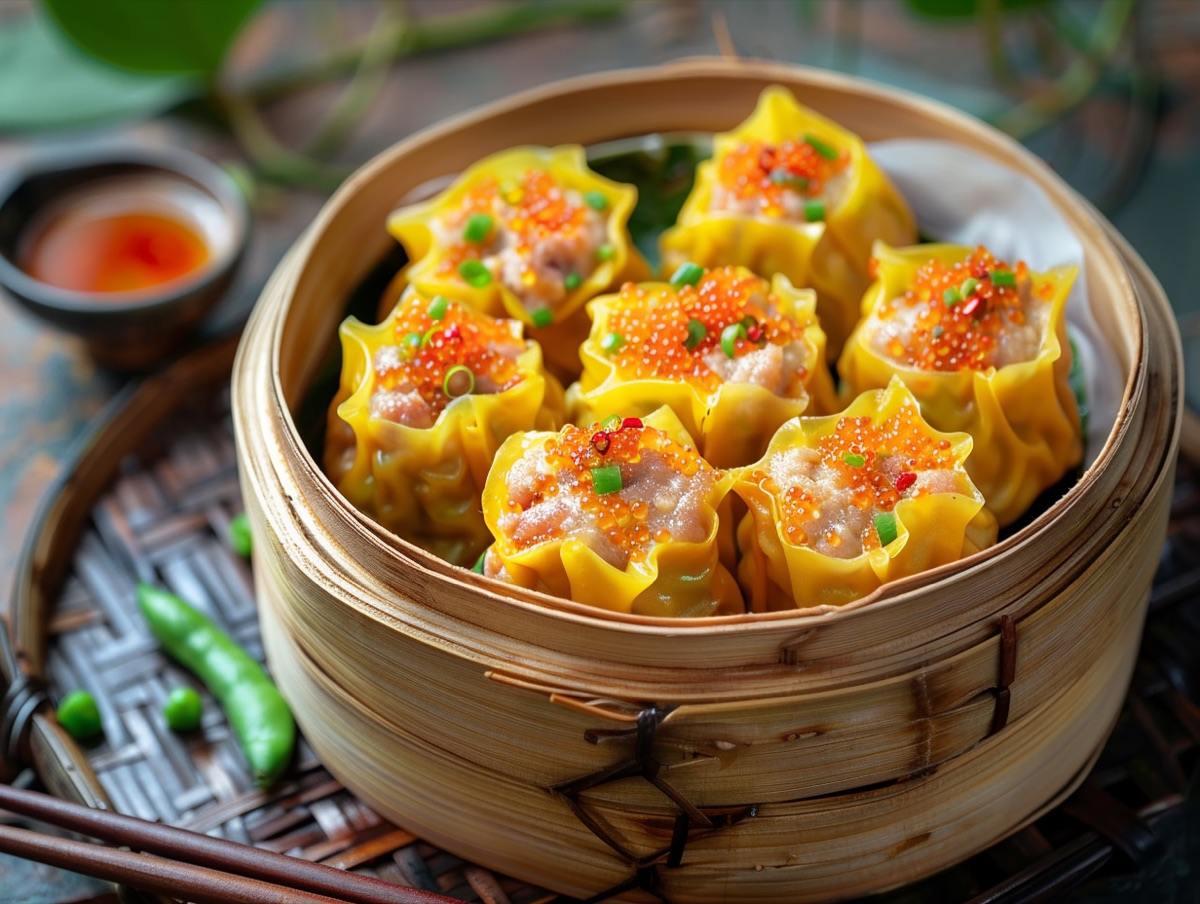
Siu Mai

Siu Mai

dim sum appetizers

Siu Mai

Pork & Shrimp Dumplings

Prep

30 min

Cook

10 min

Makes

24 dumplings

Level

intermediate

Selected by The Council — Authentic home-style technique from The Woks of Life

Siu Mai

Cantonese (Guangdong)

Siu Mai: The Open Heart of Dim Sum

Siu Mai: The Open Heart of Dim Sum

The king of dim sum. Your gateway to mastery.

Cantonese (Guangdong)intermediate30 min prep10 min cook

Siu Mai: The Open Heart of Dim Sum


The steam hits you first.

Before you see the bamboo stacks, before the carts rattle past, before you hear the rapid-fire Cantonese of the aunties calling out what they're carrying — the steam gets you. It rises in slow columns from every table, from the stacked baskets balanced improbably on forearms, from the kitchen behind its perpetually fogged porthole window. You are inside a cloud. A fragrant, pork-and-ginger cloud. And somewhere inside that cloud, arranged in a circle of six, golden-crowned and gleaming, are the siu mai.

This is the dish that taught me what Chinese cooking was actually about.


Cassie doesn't give you the easy version of anything.

When she invited me into her kitchen for the first time, I expected to watch. Maybe take notes. Maybe learn one technique and go home feeling accomplished. Instead, she handed me a pound of ground pork, pointed at the bowl, and said: "Mix. One direction. Don't stop until I tell you."

I mixed. My arm ached. She didn't tell me to stop for what felt like a very long time.

The open top means there is nowhere to hide imperfect technique. Every fold is visible. Every decision you made is on display.

What she was teaching me — though she didn't explain it until I had earned the explanation — was the foundational act of Chinese meat preparation. You mix in one direction to align the protein fibers, to build what cooks call "the bounce." The filling of a perfect siu mai isn't just seasoned ground pork. It has a quality that no Western charcuterie tradition quite names: a springy, almost elastic resilience that tells you, the moment your teeth break through the wrapper, that this was made with intention. That someone cared enough to stand over a bowl and stir in circles until their shoulder burned.

Cassie learned to cook in the way most Chinese home cooks of her generation did — by watching and being told almost nothing, by making mistakes that were corrected with a look, by slowly absorbing a grammar of flavor and technique that lived in hands and muscle memory more than in words. Her grandmother made siu mai for dim sum Sundays. Her mother adapted. She refined further, incorporating what she'd tasted in restaurants across Hong Kong and Guangzhou and Shenzhen, building her own version over decades of cooking for people she loved.

When she finally teaches you something, she teaches you the whole thing.


The word "siu mai" translates roughly as "cook and sell." It is a street food name, a working name, the name of something that came hot out of a kitchen and went straight into your hand. There is nothing precious about the etymology, which is part of what makes the dish itself so interesting: it became precious anyway.

The design is deceptively simple. A thin round wrapper is gathered up around a generous portion of filling but left open at the top — no sealed edge, no pleated crown, no hiding. Whatever is inside is visible. In a professional dim sum kitchen, this is considered the apprentice's first real test precisely because there is nowhere to conceal imprecision. The wrapper must be gathered evenly, the waist pinched at exactly the right height to create that elegant hourglass silhouette, the filling smoothed flat and topped with a single jewel of orange roe. The ones that come out lopsided or overstuffed or with the wrapper bunching unevenly — those are the ones that tell the chef you are not ready yet.

In Hong Kong's remaining handmade dim sum kitchens, which are becoming rarer every year, teams work in near-silence. One person rolls wrappers. One portions filling. One wraps. One loads steamers. They produce hundreds per hour without speaking because the work has become internalized, the rhythm shared. You do not need to talk about what you already understand in your body.

This is the kind of mastery Cassie carries into her kitchen every time she reaches for a wrapper.

That springy, elastic texture in the filling is not an accident. It is discipline made edible.


Siu mai belongs to a larger story that most people who eat it have never heard.

It did not begin in Guangdong. It began, as so many Cantonese dishes unexpectedly did, somewhere else entirely — in Inner Mongolia, where the original version was a sealed dumpling, a traveler's food, a hand-warmer that you could eat. It migrated south during the Ming Dynasty, moving along the routes of merchants and soldiers and displaced families, and when it arrived in the Pearl River Delta and encountered Cantonese culinary culture, it was transformed. The top was opened. The filling was refined. Shrimp was added to the pork, shiitake mushrooms for umami depth, water chestnuts for that clean crunch that arrives at the end of a bite and makes you want another. The orange roe garnish — traditionally fish roe or crab roe in high-end preparations — was added as a marker of quality, a signal that what was inside was worth showing off.

The Cantonese, who have built one of the world's great food cultures on the premise that fresh ingredients handled with precision and restraint will tell their own story, understood immediately what the open top meant. It meant accountability. It meant confidence. It meant: look at what we made.


Dim sum is not just a meal. This is something Cassie said to me once, and it has stayed with me in the way that true things tend to.

Yum cha — "drink tea," the practice from which dim sum emerged — began as a resting point on the Silk Road. Travelers stopped. Tea was poured. Small things to eat appeared alongside. Over centuries, the small things multiplied, diversified, became more elaborate and more codified, until they constituted an entire culinary language. The teahouse became a gathering place, a news exchange, a forum, a family table. In Hong Kong, the Sunday morning dim sum is one of the last great multigenerational communal rituals, a reason for families to assemble that requires no other justification. You show up. You order har gow and siu mai and char siu bao. You share. You talk, or you don't. You are together.

When you make siu mai at home, you are reaching into that tradition. You are doing something that links your kitchen table to ten thousand dim sum halls across a hundred years of Chinese diasporic life. That is not small. That is the kind of weight a good dish carries.


Here is what I want you to take from this before you start:

Cassie told me the real reason siu mai is the apprentice's first test is not technique. The chef is evaluating whether you are paying attention.

Making siu mai will teach you patience. Not the abstract patience of waiting, but the physical patience of doing something that requires repetition to get right. Your first few will be imperfect. The wrapper will bunch. The filling will be off-center. The waist will not be where you intended it. This is fine. This is, in fact, the point.

Keep going. After the sixth or seventh, your hands will begin to understand. After the twelfth, you will develop a feel for how much filling is too much, how much pressure the wrapper can take before it tears, where the waist wants to be. By the time you have loaded your first steamer basket and pressed your face toward the rising steam, something will have shifted.

Cassie told me once that the real reason siu mai is the apprentice's first test is not about technique. Technique can be corrected. What the chef is actually evaluating is whether you are paying attention. Whether you are present with the work. Whether you care enough to try again.

The steam will rise. The siu mai will cook. In eight minutes, you will know if you were paying attention.

I think you will be.